6 Top 2026 Home Design Trends From High Point Market Experts

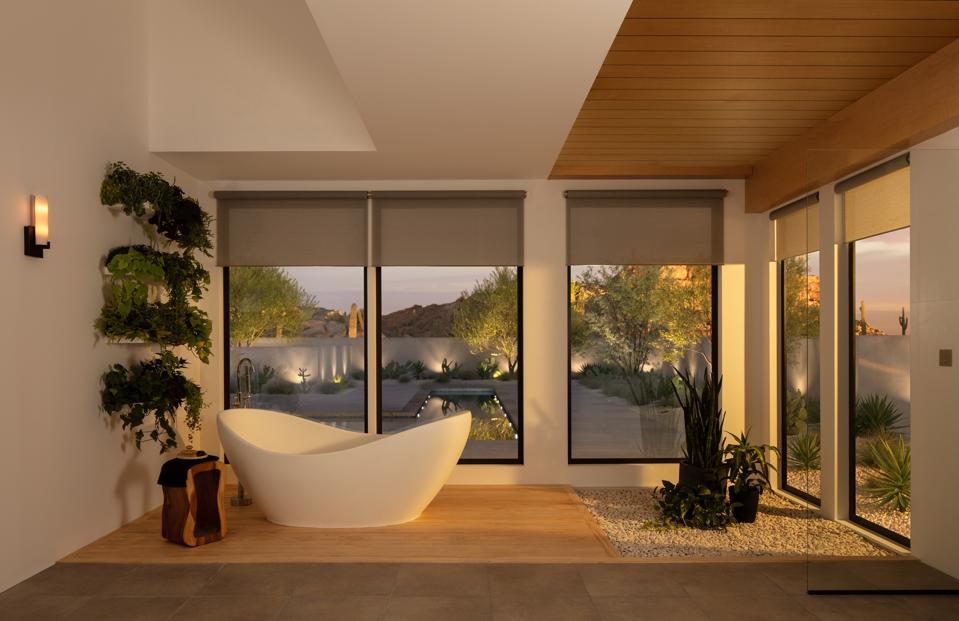
Smart shading enhances privacy, convenience, security, comfort and energy efficiency.
Palladiom Wire-Free Shading System / Lutron
If you’re a professional interior designer, there’s an excellent chance that you spent last week getting your steps in at the Fall market in High Point, North Carolina. The High Point Market, which its organizers call “the world’s largest home furnishings trade show,” is to designers what the Consumer Electronics Show (CES) is to tech pros. These 11 million square feet of exhibitor space, scattered across multiple buildings, are where many of the top home product manufacturers show off their new wares, where designers connect with new and old vendors, and where new design trends can definitely be observed if one has the acumen and stamina. I reached out to six pros to get their take on what they saw as the latest and greatest trends for 2026.
Trend One: Enhanced Kitchen and Bath Focus
Ferguson Home, one of the country’s top home products retailers, debuted this year as a sponsor to engage with the design community. Given the company’s strong focus in the kitchen and bath realm, they chose to situate themselves in the National Kitchen & Bath Association’s new flagship space. These categories have been growing at market, especially with NKBA’s successful High Point launch last year.
The increasing presence of kitchen and bathroom manufacturers and educational programming is drawing designers who specialize in those areas, many of whom are fairly new to Market. Seattle based kitchen and bath pro Paula C. Kennedy is one of these pros. Sharon Sherman of Northern New Jersey is another, but she’s been coming to market for years!
Trend Two: Wellness Focus Increasing
Ft. Lauderdale-based designer Alena Capra has been attending High Point markets since 2010, she says, and is definitely seeing a strong focus on wellness in all aspects and rooms. “I think we are seeing it across many different categories for the home now, as they all work in tandem to create one serene space.”
“The conversation around wellness was impossible to miss — expressed in natural, sustainable materials and refined details that transform the home into a sanctuary of restoration,” Ferguson’s senior director, Caroline Danielson, observes, adding, “From sculptural lighting that mirrors the rhythm of daylight to spa-inspired fixtures that calm the senses, wellness feels intrinsic to the language of modern design.” She sees it showing up on antimicrobial surfaces, circadian lighting, and enhanced appliances that preserve indoor air quality.
Overall, the Ferguson executive sees growing demand from designers and homeowners for products that “balance beauty and well-being,” as she describes it. “Designers and homeowners alike are asking for fixtures and finishes that support healthier living environments — lighting that harmonizes with natural rhythms, water experiences that restore and materials chosen as thoughtfully for their feel as for their form. It’s a holistic approach to design that mirrors the way people want to live: intentionally, comfortably and with a sense of calm.”
Sherman has seen wellness become a strong conversational focus in the 10 years she’s been coming to market. She points to the lighting trend Danielson cites, as well as a greater use of natural materials and forms, “all of which speaks to the rise of biophilic design elements,” she happily notes. She also saw solutions in noise reduction, an important feature in our multitasking homes!
Capra too points to a focus on biophilia, the influence of nature-based elements and inspirations. “In furnishings, bringing in the connection of nature to a room through the use of biophilic design is something that is very prominent, and can show up with the use of calming and/or earthy color palettes, nature inspired patterns or prints in wallcoverings and fabrics, natural materials, comfortable and ergonomic furnishings, and even massage chairs.”
When it comes to biophilic materials at High Point, Capra recalls seeing “stone (travertine is still trending), and wood in everything from light fixtures, nightstands, to accent tables, decorative books, and beyond. Woven, natural textures have also been prominent on vanities and furnishings, as well as the use of agates, and crystal such as selenite.”
Trend Three: Enhanced Functionality and Comfort
Pensacola-based interior designer Cheryl Clendenon sees wellness showing up in product improvements that benefit clients. “I think the ultimate luxury and the purest form of wellness is ease. This means designing for ease and simplifying life.” The veteran High Point attendee points to clutter-reducing furniture with storage, pieces that don’t off-gas dangerous toxins into the air, and performance fabrics that are easier to maintain.
In the comfort category, Clendenon sees demand and solutions for gathering space furnishings, like “loungier” sectionals and amenities for pets, (a growing category rescuing homeowners from ugliness), that allows them to be part of the group.
Trend Four: Enhanced Lighting
“In lighting, designers explored how material, tone, and illumination can shape emotion — with fixtures wrapped in rope or woven plant fibers, warm metals and hand-textured finishes that create a soothing, natural ambience,” Danielson shares. “Several themes stood out this season, each rooted in creating calm, intentional living spaces. Lighting brands showcased collections designed to influence mood through texture, tone and softness — where craftsmanship meets quiet innovation,” she explains.
Trend Five: Enhanced Fixtures
“In the bath and kitchen space, new fixtures and surfaces emphasized water as an experience — highlighting sustainability, tactile materials and forms that invite pause and rejuvenation,” Danielson recalls. She also notes, “Across furnishings and fixtures, the emphasis on natural and sustainable materials signaled a deepening desire for interiors that restore and ground the senses.”
Trend Six: Tech-Enhanced
It’s impossible to avoid technology-infused products. One is integrated device charging. Another is the afore-mentioned circadian lighting. Kennedy sees it in lighting controls that also enhance wellness, (while removing the hated “wall acne” of banks of switches).
One of the leading technology brands, Lutron, is back at High Point after 12 years away. “The intersection of interior design and smart home technology is more important than ever as tunable lighting and automated window treatments become integral to the overall aesthetic and wellbeing of a space,” notes Melissa Andresko, the manufacturer’s chief corporate brand ambassador. Tunable lighting is an LED-based technology that lets you change the bulb’s or fixture’s color and temperature for enhanced wellbeing.
The company’s High Point presence is centered in the NKBA section, given its importance to kitchens and bathrooms, but many of its offerings on display apply to multiple areas of a home. For example, its smart shading and lighting control systems can benefit occupants anywhere to, as Andresko declares, “enhance comfort, convenience, and wellbeing through personalized light control. These solutions help homeowners and designers make the most of natural light throughout the day and create environments that feel balanced and restorative,” she adds.
The company has seen increased interest in both categories, reflecting what the Lutron executive describes as a broader shift toward human-centric living environments.
Last Words
“When your space functions well, you feel better,” observes Clendenon. “It’s really practical psychology. Too much clutter, poor flow, lack of storage furnishings that are not comfortable (and bad lighting) elevate stress.” She assesses this market as having a strong showing in comfort, which, with joy, is the fifth facet of wellness design.
***
Note: All interviews were conducted by email or direct message between 10/30 and 11/3.
link


:max_bytes(150000):strip_icc()/spring-2026-interior-design-trends-230814_Vestige_Locust_Jpeg-4200px-300dpi_004-80bbfdeb727048e7b9d5378e4b3b5a9b.jpg "7 Interior Design Trends You’re About to See Everywhere This Spring")