I-49 expansion among ideas on table as Regional Planning Commission holds open house on transportation goals
SPRINGDALE — Expanding Interstate 49 and connecting and expanding bicycle and walking trails are among the proposals included in the Northwest Arkansas Regional Planning Commission’s Forward 2050 transportation plan.
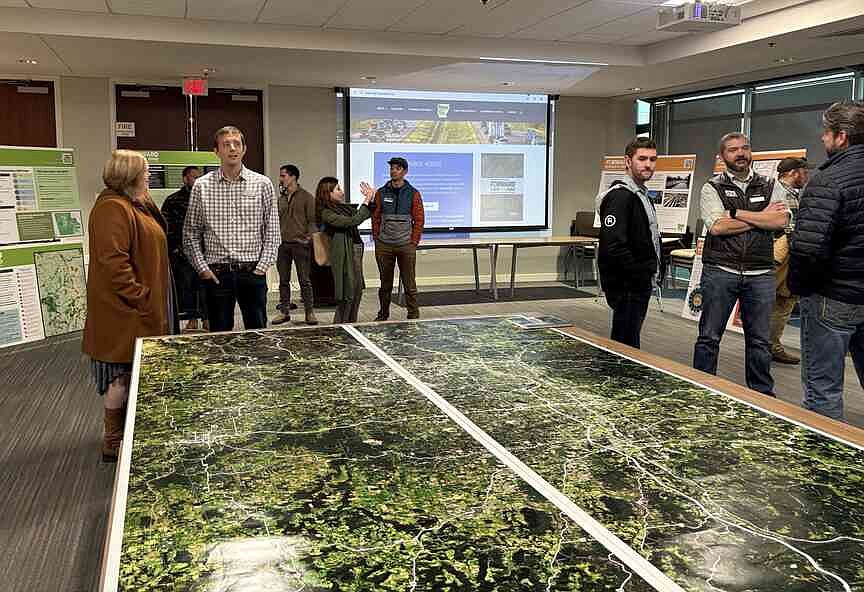
Commission staff rolled out the plan and answered questions about it during a three-hour public open house Monday, kicking off a public comment period scheduled to run through Jan. 12.
Anyone wanting to see, study or comment on the plan can find it online at nwarpc.org/transportation/mtp.
Planning included polling of area residents about their transportation needs before the plan was drawn up. Any revisions to the plan arising from public participation will take place before the commission votes on whether to accept the plan, a vote that’s expected in March.
The region is expected to reach 1 million residents by 2050, up from about 600,000 now, according to U.S. census estimates.
Philip Taldo, chairman of the Arkansas Highway Commission, attended Monday’s meeting. He called the plan sensible and attainable. In particular he was pleased by its provision for east-west connections to a road system that, in its present form, predominately runs north and south. He also called the proposed bus rapid transit corridor along U.S. 71B a practical necessity.
The proposals include a regional mobility authority empowered to ask voters to approve a tax for transportation improvements. Authorizing such a regional approach would require a change in state law. Taldo said such regional revenue would mean more state and federal taxpayer money would come to the region, not less.
“If you have some money to match funds and to pay for good planning work on a project, you have an advantage in competing for the money that’s available,” he said. “Everyone’s competing for the money that’s available.”
Anna Negrete of Springdale called the plans she saw Monday “awesome.” She said the displays on how crowded I-49 is already were particularly eye-opening. She knew traffic was bad, Negrete said, but the sheer scale of 100,000 vehicles a day was impressive.
Katherine Hudson, a member of the Johnson City Council who is also a Realtor, said the commission came up with a realistic plan. She sees in her business how fast the region is growing and the plan fits those growth patterns well, she said.
“They do a fantastic job,” she said of the commission.
Clark Eckels of Fayetteville said he opposes the portion of the plan calling for expansion of I-49. Such an expansion would incur high costs in both construction and maintenance while drawing more traffic, disadvantages that would be mitigated but not offset by measures such as adding a high occupancy vehicle lane. The lasting solution to the region’s transportation needs requires viable alternatives to driving, he said.
I-49 is a critical component of the regional transportation network but, as currently designed and built, “will not adequately accommodate the region’s future mobility needs,” the plan states.
The Arkansas Department of Transportation last completed a study of the I-49 corridor in 2006. The Regional Planning Commission in October formally requested the department initiate an updated study of the corridor.
“Completing the new I-49 Corridor Study will be an important step in advancing regional system reliability, supporting multimodal travel choices, and guiding investment decisions that align with the Forward 2050 goals and performance,” the plan states.
link